Fourth- and Fifth-Party Risk in LLMs: A Fintech Guide
Learn how fourth- and fifth-party risk emerges in LLM supply chains, why fintechs should care, and how to map hidden AI dependencies before launch.

Introduction
LLM risk hides fast.
A fintech may approve one vendor, but the real dependency chain can run through model providers, cloud hosts, logging tools, and data subprocessors.
That is why fourth- and fifth-party risk matters now. In this guide, you’ll learn what those terms mean, why LLMs make them harder to spot, and how to map the stack without building a bloated compliance program.
What Fourth- and Fifth-Party Risk Means
Fourth-party risk is the risk your vendor’s vendor creates. If you buy a chatbot, but that chatbot relies on a foundation model provider, a cloud host, or a data processor, those hidden layers can still affect your business.
Fifth-party risk goes one step deeper. It is the risk created by the vendor behind that vendor’s vendor, and it is easy to miss when teams stop at the signed contract.
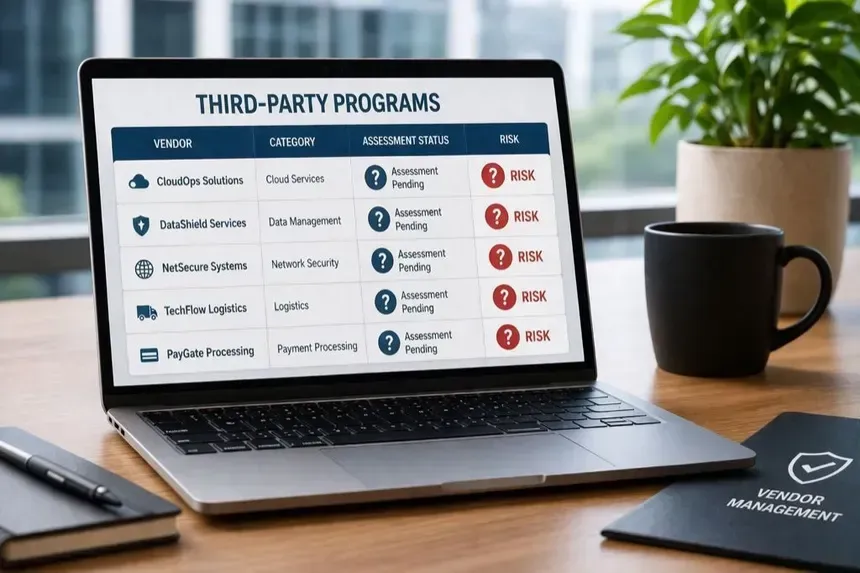
Here is the simple fintech version. Your support bot may look like one tool in procurement, but under the hood it may rely on a model provider, a vector store, a logging service, and a human review team. One clean contract does not mean one clean chain.
That is also why regulators care. They do not just want a list of named vendors. They want to know who touches data, who controls the output, and where the control gaps sit. The Interagency Guidance on Third-Party Relationships and the FDIC’s third-party risk guidance both point in that direction.
How LLMs Create Hidden Dependencies
LLMs look simple from the user side. Type a prompt. Get an answer. Behind that clean screen, though, several outside services may be working at once.
Model Providers and Hosting Layers
A basic LLM feature can depend on the model developer, an API layer, the inference host, the orchestration tool, and the cloud stack underneath it. If any one of those changes terms or behavior, your product can feel the impact right away.
That is not just a tech issue. A model update can change tone, refusal behavior, latency, or how the system handles edge cases. For a fintech app, that can affect support answers, disclosures, or internal decisioning.
A live vendor example helps here. OpenAI’s sub-processor list shows how many layers can sit behind a single model relationship. One provider can already have its own chain before your own vendor stack even starts.
Data Inputs and Training Sources
LLMs also create dependency risk through prompts, retrieval sources, fine-tuning data, and embeddings. If sensitive customer data enters the workflow, you need to know where it goes and how long it stays there.
That is where privacy and retention questions stop being abstract. OpenAI’s data controls documentation is a good reminder that buyers should ask how logs are handled, what is stored, and what can be deleted.
There is another issue too. Public or scraped data can be stale, biased, or rights-restricted. If your AI assistant pulls from bad source material, it can give confident answers that are simply wrong.
Open-Source and Subprocessor Chains
Open-source code also adds hidden layers. A vendor may not build the whole system themselves. They may stitch together an open-source model, a third-party API, an outsourced review team, and infrastructure from several partners.
That makes incident response harder. If the tool breaks or returns the wrong answer, your team has to find the root cause across a chain of suppliers. That takes time, and time is the thing fintech teams never have enough of.
For a practical security lens, the OWASP Top 10 for Large Language Model Applications is a strong place to start. For adversarial testing, MITRE ATLAS gives teams a clearer view of how AI systems fail in the wild.
Why This Matters for Fintech
Fintech does not use AI as a toy. It uses AI in support, underwriting, fraud review, marketing, and ops. That means hidden dependencies can create regulatory and customer harm fast.
Regulatory Exposure and Customer Harm
If an upstream model update changes a support answer, a customer may get the wrong disclosure. If a retrieval source is off, an internal assistant may give a bad recommendation that gets copied into a customer-facing workflow.
That is where consumer harm enters the picture. The CFPB’s chatbot research shows why customer-facing AI deserves real oversight, not just a launch checklist.
The reputational hit can be worse than the technical issue. If your team cannot explain where an AI answer came from, you look unprepared. That is a hard place to be in front of a regulator, a board, or a skeptical customer.
Vendor Due Diligence Gaps
Most standard vendor questionnaires ask about security, encryption, and incident response. That is useful, but it does not always reveal foundation-model dependencies, subprocessor chains, or human review layers.
A basic security review asks, “Is the vendor safe?”
An AI supply-chain review asks, “Who else is involved, and what do they touch?” That difference matters because the regulated entity still owns the outcome. The
CFPB Service Providers Bulletin makes that clear.
Business and Operational Delays
Unknown dependencies slow product launches, incident response, and regulator answers. Teams lose time chasing down who changed what, and engineering ends up rewriting workflows at the last minute.
That is where a fractional compliance lead can help. Fractional CCO Services can map AI dependencies into a practical control setup without forcing a fintech to hire a full-time risk leader. For a growing team, that often beats patchwork advice and guesswork.
The right support also helps legal, product, and engineering stay aligned. When compliance is part of the process early, the business spends less time on rework and more time shipping.
Step-by-Step Risk Mapping
You do not need a giant program to start. You need a clean inventory, clear ownership, and a few controls that actually get used.
Step 1. Inventory the AI Stack
Start with the full use case, not just the vendor name. List the user interface, the model provider, the hosting layer, prompt storage, logging, retrieval tools, and any external content sources.
Then split every layer into two groups:
- What your team controls
- What a vendor or subvendor controls
That small exercise usually exposes blind spots fast. A tool that looked simple on paper can turn out to have five or six moving parts in real life.
Step 2. Trace Hidden Dependencies
Next, ask the vendor for its subprocessors, cloud hosts, and data-handling partners. Check whether it uses open-source models, third-party APIs, or outsourced human review.
Then document where the data goes. Where does it enter the system? Where is it stored? Who can see it? When is it deleted? If the vendor cannot answer those questions clearly, the risk is already higher than the sales demo suggested. That is a strong sign you need more diligence before launch.
Step 3. Score the Risk by Use Case
Not every AI use case deserves the same review. An internal drafting tool is different from a customer-facing chatbot or a fraud-assist tool.
Rank each use case by:
- Business criticality
- Data sensitivity
- Regulatory impact
- Customer harm potential
- Recovery difficulty
This helps you focus on the tools that can really hurt the business. A support bot that handles account questions deserves more scrutiny than a note-taking assistant.
Step 4. Build Control Ownership
Every risk area needs an owner. Compliance should own policy and oversight. Legal should own contracts and disclosures. Engineering should own technical controls. Procurement should own vendor records and subprocessor tracking.
Then set the controls that need to exist before launch:
- Approval workflow for new AI use cases
- Data-use limits for sensitive information
- Testing before release
- Monitoring after release
- Incident escalation for model or vendor changes
If you want a more formal structure, the NIST AI Risk Management Framework is a good starting point. NIST’s Generative AI profile also helps connect general AI controls to LLM use cases.
For teams that want a more mature target state, ISO/IEC 42001:2023 offers an AI management system model. And for a security-focused lens, CISA’s AI roadmap is worth a look.
Common Mistakes to Avoid
Mistake 1 — Stop at the contract. A signed MSA does not tell you who handles the model, logs, or subprocessors.
Mistake 2 — Treat every use case the same. A writing aid is not the same as a tool that shapes disclosures or decisions.
Mistake 3 — Ignore vendor changes. If the model retrains, switches hosts, or adds subprocessors, your risk profile changes too.
Mistake 4 — Rely on one questionnaire. One intake form is not ongoing oversight. You need monitoring after launch.
Mistake 5 — Let engineering move first. If AI goes live before compliance sets guardrails, you inherit avoidable risk.
The OCC’s third-party guidance is a useful reminder that governance has to match the real relationship, not the one you wish you had.
Conclusion
AI risk is no longer just about the vendor you signed. It is about the full dependency chain behind the tool.
Map the stack, rank the risk, and assign owners before launch pressure takes over. If you want help building a lean governance setup, explore Fractional CCO Services.
FAQs
Q: What is the difference between third-party and fourth-party risk?
A: Third-party risk comes from the vendor you hire directly. Fourth-party risk comes from that vendor’s vendor, like a model provider or cloud host behind an LLM tool.
Q: Why do LLMs make supply-chain risk harder to track?
A: LLMs often depend on several outside services at once. Model APIs, hosting layers, retrieval tools, and logging systems can all sit between you and the output.
Q: How can a fintech find fifth-party dependencies?
A: Ask for architecture diagrams, subprocessor lists, data-flow maps, and security reviews. You want to know where data enters, where it travels, and who can touch it.
Q: What controls should be in place before using an LLM?
A: Set data restrictions, approval steps, testing rules, monitoring, and incident response paths. Also assign a clear owner for each control.
Q: Do small fintechs really need to worry about this?
A: Yes. Smaller teams often rely more on vendors and have fewer internal checks. That can make hidden AI dependencies more dangerous, not less.