HR Tech Stack: Why Every People Team Runs an AI Program
A practical guide to the HR Tech Stack that shows people teams how to launch AI programs in six weeks while managing data, bias, and audit readiness.

Introduction
HR now runs AI. Are you ready to treat HR like a product team running an AI program? Can your people team deploy screening, onboarding, and performance scoring without tripping regulators or bias traps?
This guide shows the stack components, governance checkpoints, and a six-week rollout plan you can actually run. Follow these steps to launch AI-enabled people workflows fast and without regulatory surprises.
Why Every People Team Runs AI Programs Now
AI speeds routine work, personalizes experiences, and lowers cost per interaction. Recruiters use automated screening to move candidates faster. Learning teams deliver tailored courses at scale. People ops automate routine casework. Managers get AI-assisted performance insights.
SHRM research shows HR AI adoption is rising and will reshape hiring and talent practices.
Cross-industry precedents matter. Ad tech teaches consent and personalization management. Fintech shows how to keep rigorous audit trails and versioning. Healthcare forces tight privacy and bias controls. Copying these playbooks reduces risk and speeds adoption.
Quick ROI frame: time saved × hires per month. Cut resume triage from 10 minutes to 2 minutes across 200 hires and you save roughly 267 hours monthly. That’s a concrete ballpark to justify tooling.
Watch for blind spots. Privacy laws, undocumented training data, and missing audit trails are common pitfalls. Two short scenarios make the point:
- Hiring pipeline: An automated scorer filters candidates. No documented features or bias tests mean exposure to EEOC scrutiny.
- Performance scoring: A model lowers scores for remote workers correlated with protected traits. Without mitigation, this creates disparate impact risk.
A short anecdote: a mid-market HR team paused a rollout when a hiring panel flagged unexplained score differences. Shadow testing found a proxy feature. The fix was straightforward: remove the proxy and add human review for edge cases.
Start small. Test fast. Build responsibly.
Core Components of the Modern HR Tech Stack
Every stack has three layers: data, model, and orchestration. Treat each as both a product and a compliance problem.
1) Data layer: sources, quality, permissions
Inventory first. Make a one-page data map for each use case.
- Catalog sources: ATS, HRIS, Slack, LMS, payroll, background checks.
- Flag PII: SSN, disability status, compensation, disciplinary records.
- Map lineage: where data starts, how it’s transformed, who consumes it.
Use the NIST Privacy Framework to map lawful bases and retention flows. Require vendor processing agreements. Record candidate consent when needed.
Retention policy examples:
- Rejected applicants: delete after X months unless consented.
- Hired employees: tie retention to employment records and legal holds.
This one-page map becomes your simplest audit artifact. If an auditor calls, you’ll be able to answer in hours, not weeks.
2) Model layer: selection, fine-tuning, bias controls
Pick your approach based on risk and control needs:
- Off-the-shelf vendor models: use for low-risk notifications.
- Vendor models with fine-tuning: use for screening when you can audit inputs.
- In-house models: keep for high-stakes decisions that need explainability.
Run three fast checks for every model:
- Training data provenance.
- Feature selection review.
- Disparity analysis on outcomes.
Starter toolset (keep this compact): IBM AIF360 for bias metrics and Fairlearn fairness toolkit for mitigation strategies. Add Aequitas for quick disparity tables when you need a fast report.
Sandbox testing steps:
- Shadow-mode evaluation.
- A/B testing against a human baseline.
- Pre-defined performance thresholds.
Document model cards and training artifacts. Use Google's Model Card Toolkit to standardize documentation. Keep reproducible notebooks and version tags so you can show exactly what changed between releases.
3) Workflow and orchestration layer
Translate model outputs into real decisions. Integrate outputs into Jira, HRIS approvals, and Slack notifications.
Add human-in-the-loop gates for high-risk actions:
- Interview shortlists.
- Offer rescinds.
- Compensation changes.
Explainability tools like SHAP produce per-decision attributions. Use them when a manager asks why a candidate dropped off a shortlist. Feature flags and staged rollouts limit early exposure.
Log who saw what, when, and why. That supports audits and fast rollback decisions. Treat model outputs as recommendations, not final actions. Humans sign off when risk crosses your threshold.
Governance, Compliance, and Audit Readiness
This is where the stack becomes defensible practice.
A) Policy framework and role definitions
Update HR policies to include AI usage, accountability, and escalation paths. Define owners across product, HR, legal, and compliance. Publish a one-page AI use-case register that lists purpose, data, owners, risk level, and mitigations.
Use Microsoft's responsible AI checklist for a governance template. If you're the COO, assign a single owner for the audit binder and one for day-to-day decisions. That eliminates "who signed off" delays.
B) Regulatory checkpoints and state considerations
Map the applicable rules: EEOC employment guidance, FTC consumer-protection principles, and state privacy laws. Use the IAPP state privacy tracker to check state privacy obligations before processing applicants across states. Review FTC materials where HR systems touch eligibility or benefits.
Add jurisdictional notes when you expand your hiring footprint. For example, California and Virginia have specific privacy expectations that can change how you record consent and retention.
C) Audit readiness and exam playbook
Build an audit binder with short, labeled folders:
- Data lineage documentation.
- Model cards and training artifacts.
- Evaluation results and fairness reports.
- Governance meeting minutes and decision logs.
- Remediation log with issue, fix, and owner.
Use AuditBoard templates for control matrices and checklists. Schedule quarterly compliance reviews and tabletop exams. Follow model cards & datasheets best practices for expectations.
Make the binder useful. Label items for a regulator so you can hand over exactly what they'll ask for.
Implementation Roadmap: 6-week Pilot to Scale
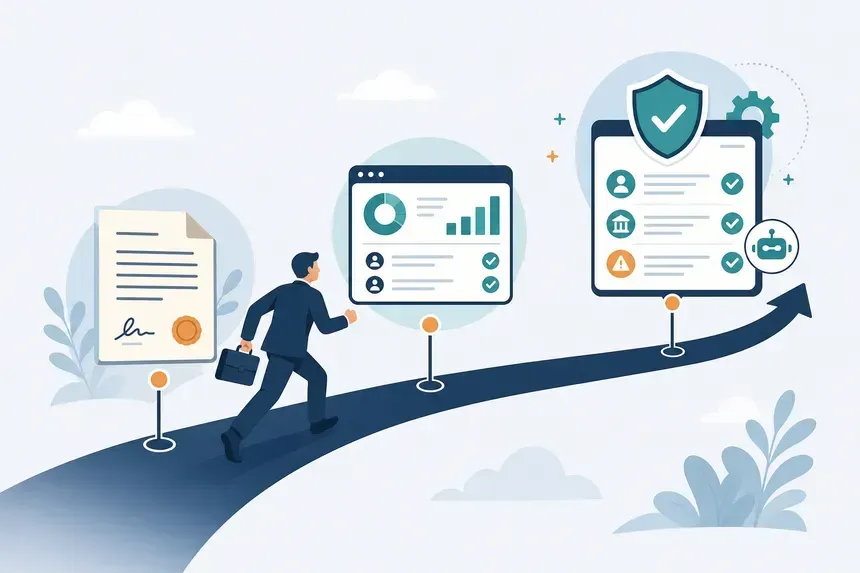
Follow this phased plan with numbered steps.
Week 0–2: Assess and scope
- Run a prioritization workshop with HR, product, legal, and engineering. Ask: which use case blocks your next release?
- Map data access, compute needs, and a simple risk matrix. Produce the one-page data map for each prioritized use case.
- Produce a one-page project brief with success metrics and rollback criteria.
Quick resource: crowdsource vendor experience in practitioner communities r/Compliance, r/fintech.
Week 3–4: Build, test, and baseline
- Stand up a sandbox and ingest a minimal, privacy-safe dataset.
- Run shadow-mode evaluations and bias checks with AIF360 or Fairlearn.
- Create model cards, evaluation notebooks, and KPI dashboards.
Week 5–6: Launch, monitor, and iterate
- Staged rollout with human oversight and rollback gates.
- Monitor technical metrics and user feedback. Count false positives and false negatives separately.
- Run a 30/60/90-day review covering drift, fairness, and HR impact.
- Prep the audit binder for the first internal review.
Short, human dialogue to clarify decision flow: HR lead: "Can we launch this sprint?" CCO: "Not until we finish the bias check and add human review for offers." That exchange moves decisions forward and keeps product momentum.
Conclusion — Key Takeaways and Next Steps
Map your data. Enforce governance. Run staged pilots with human checks.
Do this now: finish the one-page pilot brief and schedule a compliance checkpoint. If you need a fast exam playbook or state-by-state mapping, consider an on-demand compliance partner to plug into your pilot.
Schedule the workshop this week. Get the right owner for the audit binder. You’ll prevent delays later.
FAQs
Q: Does applicant scoring count as a "decision"?
A:
Yes. EEOC treats automated hiring tools as potential sources of discrimination; always include human review for final adverse actions.
Q: What are basic retention limits for candidate data?
A: Limits vary by state. Map retention to purpose and delete rejected resumes after a documented window unless you have consent. Use NIST privacy principles to justify policies.
Q: When use third-party vs in-house models?
A: Use third-party for low-risk features. Build in-house for high-stakes decisions that require explainability and data control.
Q: What logs will auditors ask for?
A: Data lineage, model training artifacts, evaluation results, decision logs showing who reviewed outputs, explainability reports (SHAP/LIME), and remediation records.
Q: How to measure disparate impact?
A:
Compute disparity ratios and adverse impact metrics during testing. Use AIF360 or Fairlearn to produce auditor-friendly reports.
Q: Affordable bias tests without data science?
A: Run shadow-mode sampling, use Aequitas scripts for quick disparity checks, and engage a fractional compliance review for exam prep.
Q: Who should own the audit binder?
A:
Assign a single owner—preferably someone with cross-functional reach who can gather artifacts quickly. That person keeps the binder up to date between audits.